
The Simplest Way to Start Your Business Legally
Starting a business for the first time can feel overwhelming. There are structures to choose from, documents to gather, registrations to complete, and compliance requirements to understand. But for many first-time entrepreneurs — freelancers, consultants, traders, home-based businesses, and small service providers — the answer to that complexity is often simpler than they think.
A sole proprietorship is the most straightforward business structure available in India. It is owned and operated by a single individual, requires minimal formalities to set up, and allows the owner to get started quickly without the compliance burden of a company or LLP.
This guide covers everything you need to know about sole proprietorship registration — what it means, who it suits, what the process involves, and how eLegalKart can help you set it up correctly from the start.
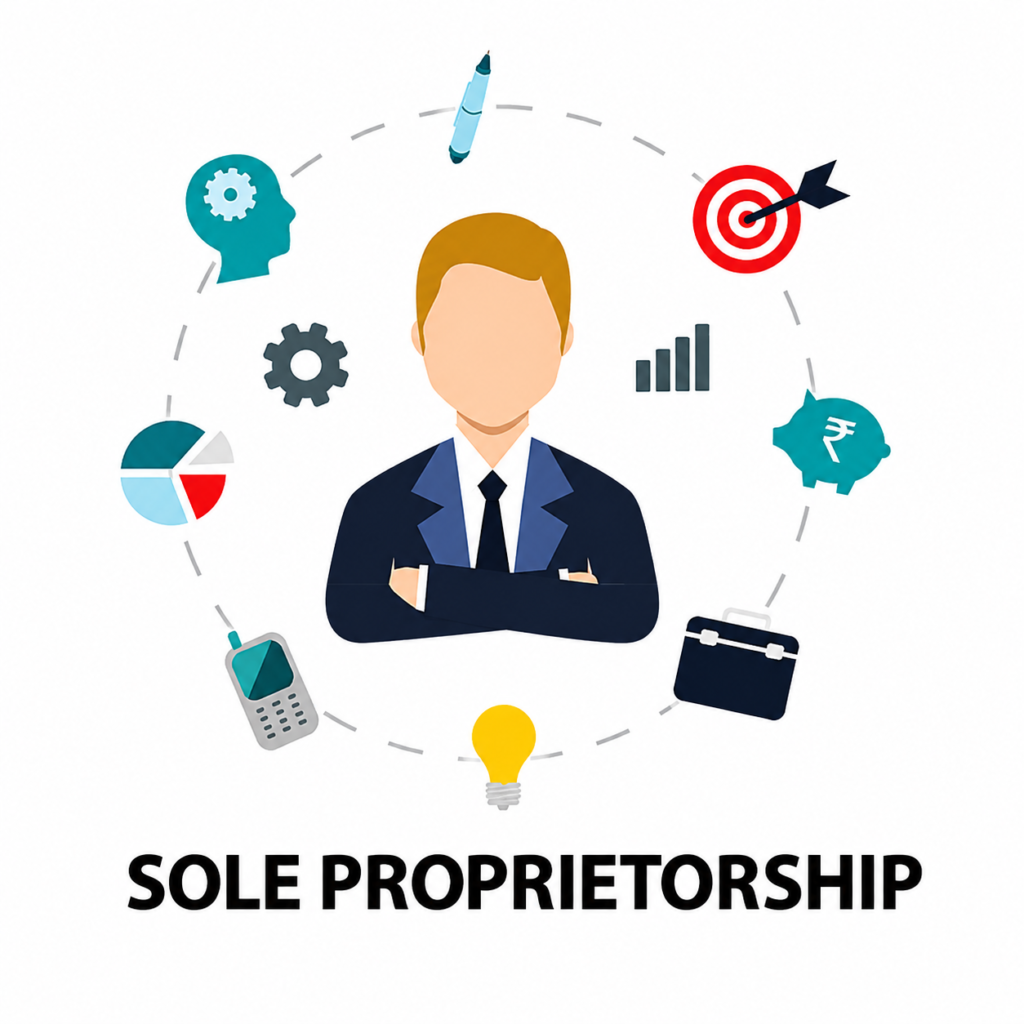
What is a Sole Proprietorship?
A sole proprietorship is a business owned and controlled by a single person. There is no legal distinction between the owner and the business — they are, in the eyes of the law, the same entity. The owner receives all the profits, bears all the losses, and is personally responsible for all the obligations the business incurs.
This simplicity is both its greatest strength and its primary limitation. On one hand, it is easy to set up, inexpensive to maintain, and straightforward to wind down. On the other hand, the absence of a separate legal identity means the owner’s personal assets — savings, property, and other possessions — are not protected if the business faces debt or legal claims.
Despite this limitation, sole proprietorship remains the most common business structure in India, particularly among individuals who are just starting out, testing a business idea, or operating at a scale where limited liability is not yet a pressing concern.
Who Should Consider a Sole Proprietorship
Not every business is suited to this structure, but it works very well for a specific range of situations.
Freelancers and independent professionals — writers, designers, photographers, developers, consultants, and coaches — who work independently and want a simple legal framework for invoicing clients and managing their taxes.
Small traders and retailers — shopkeepers, vendors, and local traders who operate from a fixed location and serve a local market.
Home-based businesses — individuals running businesses from home, such as catering, tailoring, tutoring, or handmade products.
First-time entrepreneurs — those who want to test a business idea before committing to a more complex structure like a private limited company.
Service providers — individuals offering services in sectors like beauty, repair, transport, or delivery who need a basic legal identity to operate.
If your business is at an early stage, your revenue is modest, you operate alone, and you are not seeking external investment, a sole proprietorship is likely the right starting point. As your business grows, you can always transition to a more formal structure.
Key Registrations Required for Sole Proprietorship
Since there is no standalone sole proprietorship registration certificate in India, the business is established through a combination of registrations. The ones you need depend on your business type, location, and turnover.
GST Registration
If your annual turnover exceeds ₹40 lakhs (₹20 lakhs for service providers in most states), GST registration is mandatory. Even below this threshold, voluntary GST registration is often advisable — it allows you to issue tax invoices, claim Input Tax Credit, and work with corporate clients who require a GSTIN from their vendors.
Shop and Establishment Registration
This registration is governed by state-specific laws and is required for most businesses operating from a physical location — shops, offices, salons, studios, eateries, and similar establishments. It is obtained from the local municipal authority and serves as proof that your business legally operates at a given address.
MSME Registration (Udyam Registration)
While not mandatory, MSME registration is highly recommended for sole proprietors whose investment and turnover fall within the defined thresholds. It is free, done online through the Udyam portal, and unlocks a range of benefits including priority sector lending, protection against delayed payments, and access to government schemes and subsidies.
Trade License
Certain types of businesses — particularly those in food, manufacturing, health services, or other regulated sectors — require a trade license from the local municipal body. This confirms that the business complies with local safety and operational standards and is permitted to carry out its specific trade activity.
Professional Tax Registration
In several states, including Maharashtra, Karnataka, West Bengal, and others, sole proprietors are required to register for professional tax and pay it annually. The amounts are modest, but non-compliance can result in penalties.
PAN and Bank Account
While a PAN card is personal to the individual, sole proprietors often operate using their personal PAN as the business PAN since the two are not legally separate. A dedicated current bank account in the name of the business — with the proprietor’s name — is essential for professional credibility and clean financial management.
Advantages of a Sole Proprietorship
Understanding why so many businesses choose this structure helps clarify whether it is right for you.
Ease of setup. Compared to registering a company or LLP, establishing a sole proprietorship is significantly simpler. There are fewer documents, lower fees, and no requirement to draft complex constitutional documents like a Memorandum of Association.
Complete control. As the sole owner, every decision rests with you. There are no co-founders, shareholders, or board members whose approval you need. This makes the business agile and responsive.
Minimal compliance burden. Sole proprietors do not need to file annual returns with the Ministry of Corporate Affairs, hold board meetings, or maintain complex statutory registers. The compliance obligations are far lighter than those of a company.
Direct tax benefits. The income of a sole proprietorship is taxed as personal income under the individual tax slabs. This can be advantageous for businesses with modest income, where the effective tax rate may be lower than the corporate tax rate.
Simple to wind down. If the business does not work out, closing a sole proprietorship is straightforward. There is no formal dissolution process required with the government.
The Process of Setting Up a Sole Proprietorship with eLegalKart
Setting up a sole proprietorship correctly involves identifying which registrations apply to your specific business, gathering the right documents, and completing the applications accurately. While the individual steps are not overly complex, getting them right from the start saves time and prevents the need to correct mistakes later.
eLegalKart’s team of qualified professionals guides you through the entire process:
Step 1 — Understanding your business: We begin by understanding your business activity, location, expected turnover, and sector. This helps us identify precisely which registrations you need.
Step 2 — Document preparation: We guide you on the documents required — typically your PAN card, Aadhaar card, address proof, and business address details — and help you prepare them correctly.
Step 3 — Filing the applications: Our team handles the filing of all relevant registrations — GST, shop and establishment, MSME, trade license, or others — on your behalf, ensuring accuracy and completeness.
Step 4 — Follow-up and delivery: We track the status of your applications and follow up with the relevant authorities until your registrations are approved and delivered.
Step 5 — Post-registration guidance: Once your registrations are in place, we advise you on your ongoing compliance obligations — return filing deadlines, renewal requirements, and record-keeping practices.
Why Choose eLegalKart for Sole Proprietorship Registration?
eLegalKart understands that for a first-time business owner, every rupee and every hour matters. Our approach is straightforward — we identify exactly what your business needs, handle the process efficiently, and keep you informed at every step.
We do not believe in recommending unnecessary registrations or overcomplicating a process that, for most sole proprietors, should be simple and affordable. Our team of chartered accountants, legal professionals, and compliance experts brings the knowledge and experience to get your business set up correctly — so you can focus on running it.
Whether you are a freelancer issuing your first invoice, a trader opening your first shop, or a home-based entrepreneur formalizing what has been an informal operation, eLegalKart is here to make sole proprietorship registration smooth, clear, and completely stress-free.