
Why Every Small and Medium Business in India Should Take This Step
India’s small and medium business sector is the engine of the national economy. It employs more people, operates across more sectors, and contributes more to GDP than most people realise. Behind every large industry is a network of smaller enterprises — manufacturers, suppliers, service providers, and traders — who keep the wheels turning.
Yet many of these businesses operate without a simple, free registration that could significantly improve their access to credit, protect them against delayed payments, connect them to government support schemes, and open doors to public sector contracts. That registration is MSME registration — a government acknowledgement that formally recognises your business as a micro, small, or medium enterprise and gives it access to a framework of support that is genuinely valuable.
This guide explains what MSME registration is, who qualifies, what the process involves, what benefits it unlocks, and how eLegalKart helps businesses get registered quickly and correctly.
What is MSME Registration?
MSME registration is the process of formally enrolling a business under the Micro, Small and Medium Enterprises Development Act, 2006 — commonly called the MSMED Act. The registration is done through the Udyam Registration portal, which was introduced by the Ministry of Micro, Small and Medium Enterprises in July 2020, replacing the earlier Udyog Aadhaar system.
Once registered, a business receives a Udyam Registration Certificate and a unique Udyam Registration Number (URN). This certificate is the official recognition of the business as a micro, small, or medium enterprise, and it is the document required to access the schemes, protections, and benefits available under the MSME framework.
The registration is completely free of cost, fully online, and based on self-declaration. There are no fees to pay, no physical documents to submit, and no government officer to visit. The entire process can be completed on the Udyam portal in a single session — provided the relevant details are available.
Who Qualifies for MSME Registration?
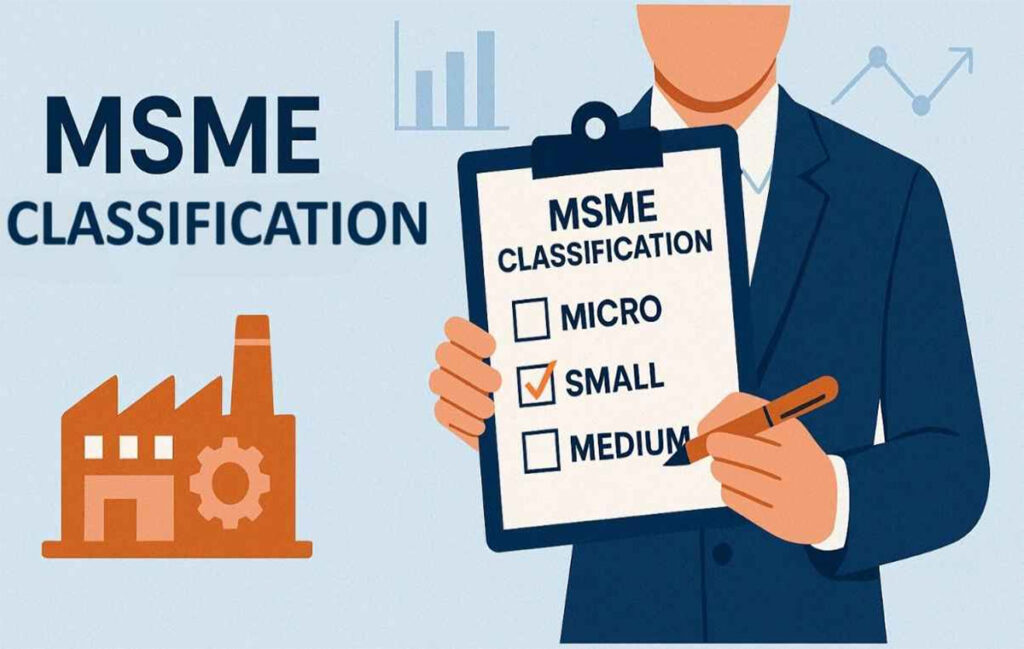
The MSME classification is based on two criteria — investment in plant and machinery or equipment, and annual turnover. Both thresholds must be met to qualify under each category.
Micro Enterprise
- Investment: Not exceeding ₹1 crore
- Annual Turnover: Not exceeding ₹5 crore
Small Enterprise
- Investment: Not exceeding ₹10 crore
- Annual Turnover: Not exceeding ₹50 crore
Medium Enterprise
- Investment: Not exceeding ₹50 crore
- Annual Turnover: Not exceeding ₹250 crore
These revised thresholds — introduced in 2020 — brought a significantly larger number of businesses within the MSME framework compared to the earlier, narrower definitions. Both manufacturing and service sector businesses are eligible, making MSME registration accessible to a wide range of enterprise types.
It is worth noting that the investment and turnover figures are calculated on a composite basis — meaning both criteria must fall within the specified limits for the applicable category. If a business exceeds either criterion for a given category, it moves to the next classification.
Any business entity — sole proprietorship, partnership firm, LLP, private limited company, Hindu Undivided Family (HUF), co-operative society, or trust — can apply for MSME registration, provided it meets the relevant thresholds.
The Udyam Registration Process
MSME registration through the Udyam portal is designed to be as simple as possible. The government has integrated it with PAN and GST databases, which means most of the business information is auto-populated from existing government records.
Step 1: Visit the Udyam Registration Portal
The application is filed at udyamregistration.gov.in. The portal has separate sections for new entrepreneurs who do not have a prior Udyog Aadhaar registration and for those migrating from the earlier system.
Step 2: Aadhaar Verification
The application begins with Aadhaar-based verification of the applicant. For a sole proprietor, the proprietor’s Aadhaar is used. For a partnership firm, a partner’s Aadhaar. For a company or LLP, the Aadhaar of an authorised director or designated partner is required.
The Aadhaar number is verified through OTP sent to the registered mobile number. This step links the registration to a verified individual identity, which is the government’s mechanism for ensuring accuracy and preventing duplicate registrations.
Step 3: PAN and Business Details
After Aadhaar verification, the applicant enters the PAN of the enterprise (or the individual, in the case of sole proprietors). The system automatically fetches information from the Income Tax database — including the business name, type of organisation, and in many cases, financial figures.
Details that need to be entered manually include:
- Name of the enterprise and its official address
- Date of commencement of business
- Bank account details of the enterprise
- Main activity — whether manufacturing or services
- NIC code (National Industrial Classification) for the business activity
- Number of employees
Step 4: Declaration and Submission
The applicant declares that the information provided is correct and submits the form. No documents need to be uploaded — the registration is entirely based on self-declaration, with the information cross-verified against PAN and GST databases.
Step 5: Udyam Registration Certificate
Upon successful submission, the Udyam Registration Certificate is generated immediately and can be downloaded from the portal. The certificate contains the Udyam Registration Number (URN), which serves as the permanent identification number for the MSME.
The entire process from start to certificate can be completed in under an hour when the necessary PAN and Aadhaar details are available.
MSME Registration and Its Connection to Other Compliances
MSME registration works alongside — not instead of — other business registrations. It does not replace the need for GST registration, company or firm registration, trade licenses, or income tax compliance. Rather, it complements these by adding a layer of recognition and benefit within the MSME framework.
For businesses that are already registered as companies, LLPs, or partnership firms, adding Udyam registration is a straightforward additional step that enhances the profile of the business in the eyes of lenders, government buyers, and larger corporate clients.
For businesses that are newly setting up, completing MSME registration alongside or shortly after the primary entity registration is good practice — it ensures that the business can access credit and government benefits from the earliest stage of its operations.
Updating and Managing Your Udyam Registration
MSME registration is not a static document. As a business grows — in turnover and in the scale of its investment — it may move from one MSME category to another or eventually graduate beyond the MSME classification altogether.
The Udyam portal allows registered businesses to update their details when there are changes — in turnover, investment, address, or business activity. Keeping the registration current ensures that the correct classification is maintained and that the business continues to qualify for the benefits applicable to its category.
If a business’s turnover and investment exceed the medium enterprise thresholds for three consecutive financial years, it loses its MSME status and must be reclassified accordingly. This is a natural consequence of growth and is handled through the portal.
How eLegalKart Manages Your MSME Registration
While the Udyam registration process is designed to be straightforward, the accuracy of the information entered — particularly the NIC code, financial figures, and entity details — matters significantly for correct classification and effective access to benefits.
eLegalKart’s team handles MSME registration for businesses across all structures and sectors:
Eligibility Assessment: We review your business’s investment and turnover figures to confirm eligibility and identify the correct MSME category — micro, small, or medium.
NIC Code Identification: We identify the accurate National Industrial Classification code for your primary business activity, ensuring that your registration correctly reflects what your business does.
Aadhaar and PAN Verification: We guide the authorised signatory through the Aadhaar OTP process and ensure that the correct PAN — entity or individual as appropriate — is used for the registration.
Portal Filing: We complete the Udyam registration form with accurate information and submit it through the portal on your behalf.
Certificate Delivery and Guidance: Once the Udyam Registration Certificate is issued, we deliver it to you and explain how to use it — for loan applications, tender participation, delayed payment claims, and fee concessions.
Post-Registration Updates: When your business details change, eLegalKart handles the update process on the Udyam portal to keep your registration current and accurate.
Why Choose eLegalKart for MSME Registration?
MSME registration is free, but the value it creates is not trivial. The difference between a correctly classified and accurately registered MSME and one with errors in its Udyam record shows up when it matters most — in a loan application, a government tender submission, or a delayed payment dispute.
eLegalKart brings the care and accuracy that this process deserves. Our professionals understand the classification criteria, the NIC code framework, and the downstream uses of the Udyam certificate — and we ensure that every detail in your registration supports the purposes you will actually use it for.